
(Yes - even you! 🫵🏻)
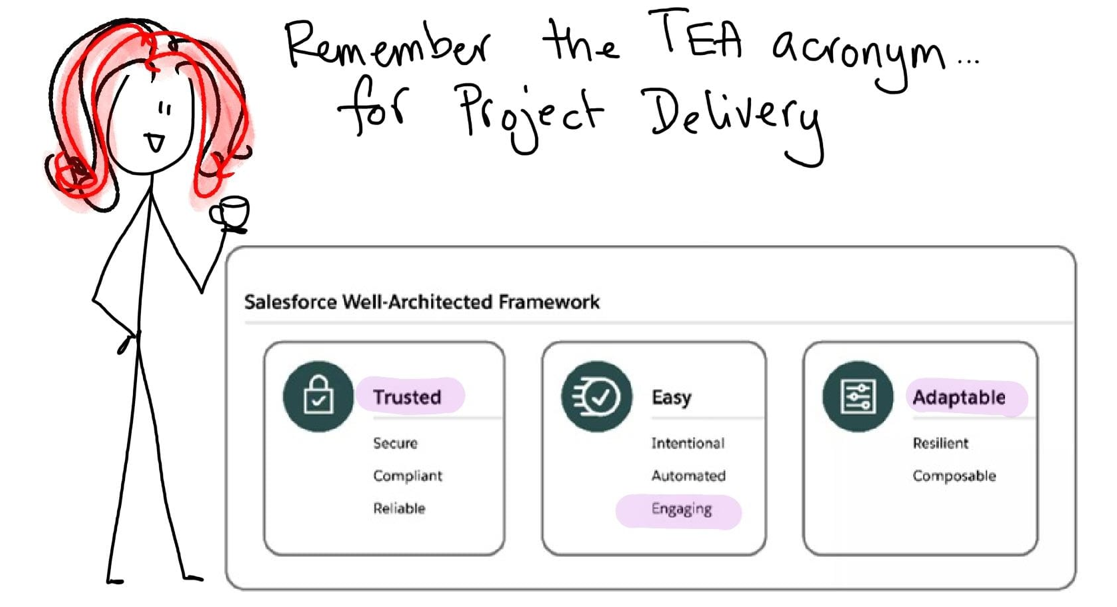
Well Architected Framework TEA 🧋🍵🫖 anyone?
Heya,
Sorry for the delayed newsletter - in the last few weeks I was in Wroclaw Poland, and then I got engaged for a new consulting contract, and then we bundled the family for a trip back to Malaysia for my dad's 80th birthday! Phew!
I am still here by the way - wilting slightly in the humidity but enjoying the food-ing, friend-ing and the family-ing very much! 😍🥰🤤🫶🏻❤️
Last newsletter issue I talked about Why Change Management for Volunteer Orgs is a Different Beast 🦩 but I did say I'd give you a sneak peek of my talk at Polish Dreamin', on the topic of "The Well-Architected Project Team: Why Everyone Needs an Architect Mindset."
It was really fun as everyone was super engaged! haha! I especially noted the PTSD on people's faces when I described a project manager who skips testing to hit a deadline? 😆
And how everyone related when I gave examples of projects not behaving in a well-architected way.
So I wanted to share the heart of what I talked about, because I think it's something every single one of us in the Salesforce ecosystem needs to hear.
The assumption that tanks projects
Whose job it is to make sure the system is scalable, robust, resilient?
"That's the architect's job." 🙄
It's "someone else's" problem.
And it's often said by someone who's about to make a decision that will absolutely become the architect's problem.
The Salesforce Well-Architected Framework gives us three pillars:
Trusted
Easy
Adaptable
... or TEA (as my lovely friend Louise Lockie would acronym it 🫖🍵🧋) makes it easy to think that the job belongs to someone else.
However - what I've seen across 30 years of project delivery is this: the best-architected systems don't come from the best architect in the room.
They come from the most architecturally curious people across the whole team.
Every role carries architectural risk
At Polish Dreamin', we did a live show of hands whenever I asked a question and it really tickled me to see so many hands shoot up and the amount of vigorous nodding made it hard for me to keep going!
Here's an example of some of the questions - so put your hands up if you've experienced this in a project!
🍩 The BA who writes a customer rating field as free text. (Your reporting will break. I promise.)
🍩 The PM who agrees to a timeline that skips proper testing, or forgets to cost in data migration (or even sandbox deployments to the various environments)
🍩 The dev who hard-codes something that should be configurable because it's quicker right now.
🍩 The QA who only tests the happy path. 🙄
🍩 The client who signs off UAT without actual end users, and then wonders why adoption fails at go-live. Siiighh.
None of these are intentional or even malicious (well, not always anyway)
They're human.
But they all have architectural consequences - and that's the mindset shift I want to talk about.
One question per role
If I could tattoo one question into the brain of each person on a project team, it would be this:
➡️ BA / Functional Consultant: Does this new requirement assume something about the data model I haven't yet verified?
➡️ Project Manager: Have I actually costed the non-functional work — testing, deployment, migration?
➡️ Developer / Configurator: What happens when the business scales?
➡️ QA / Tester: What breaks downstream if this breaks?
➡️ Client: Do I understand the full cost of this change — financially, technically, and humanly?
The architect should be the final voice.
Not the only voice.
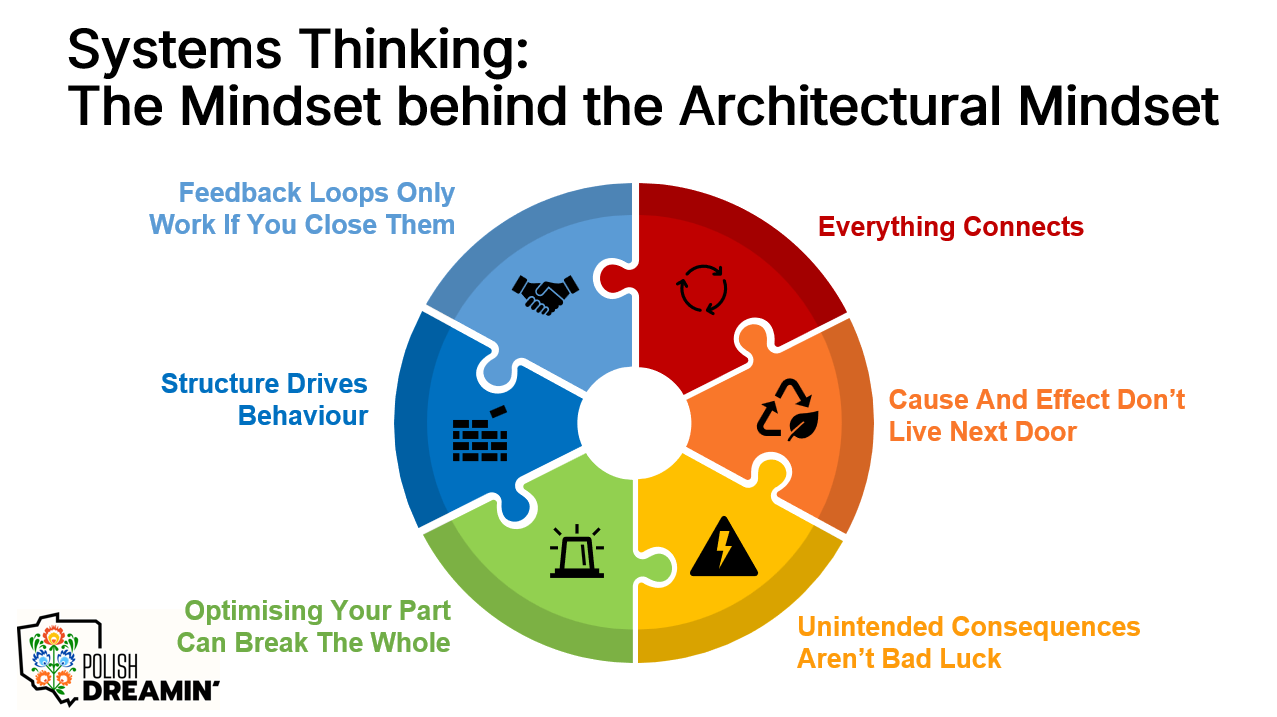
Systems Thinking - The mindset behind the mindset
Everyone talks about this mysterious "architectural mindset" but what does it really mean?
Especially for those who thinks 'architect' is someone techie, someone cleverer than them, or someone with special 'yoda' abilities. 😬
Well, what it is... is Systems thinking.
- Everything connects. Your decision lives in someone else's problem.
- Cause and effect don't live next door. You won't always see the consequence immediately.
- Optimising your part can break the whole.
- Structure drives behaviour. (Commission structures. Government policies. Picklist values. All of it.)
- Feedback loops only work if you close them - and closing them means communicating, not just acting.
It's thinking through the consequence of your actions and how it relates to other parts of the big picture - in a systemic thinking manner.
Such as unintended consequences. 🫣
The snake farm example got a big laugh, by the way. (Bounty on dead snakes → people start farming snakes → more snakes than you started with. Unintended consequences are real, people.) 🐍
I think I can talk about systems thinking until the cows come home... it's a topic that has fascinated me for years! I mean it answers why I've never believed "This one trick that will fix your belly fat" clickbait 🙄
Not enough people understand "systems thinking".
It's the difference between
👉🏻Western and Eastern culture
👉🏻Individualistic vs Collectivistic
👉🏻"Me" vs "we"
It's really a community vs individual.
When you zoom out into a macro lens, and explains why 'soundbite' easy fixes really doesn't do a jot for wicked complex problems where systems are intertwined.
Anyway let me get off my soapbox or this newsletter will be unbearably long!
If you want to go deeper on this kind of thinking - that's exactly what we dig into every week at #ZenClub. Come join us.
I've got a couple more dreamin conferences coming up - Albania Dreamin' on 25 Apr, TrueNorth Dreamin' in Toronto on 11-12 May, CzechDreamin 29 May, London's Calling on 5 June and Portugal Dreamin on 19 June.
This year I am intentionally supporting dreamin community conferences, so am hoping to see you at one of these!
If you coming to any of the above events, let me know and come say hi 👋🏻 It would be lovely to meet you! ☺️
Anyway until the next newsletter issue - take care!
x Pei 💜
P.S. If you love this newsletter please forward to your friends and colleagues and get them to subscribe here (where you can also read previous posts from when I migrated to the platform). 🥰
P.P.S. All three of my books - Salesforce Discovery 101, Successful Salesforce Projects 101, and Salesforce Consulting 101 - are on Amazon if you want to go even deeper.

Responses