
OnThePeiroll
Hi there,
I'm taking a brief pause from our Well-Architected series this week because last Friday's #ZenClub session was really good and I wanted to talk about it. 🥰
I wrote a small post on LinkedIn about the power and politics of "The Messy Merger" case study and got a lot of questions (especially since I also shared comprehensive notes from our Friday session) so I thought I'd write about it in this week's newsletter!
We spent 80 minutes wrestling with a fictional case study that was a proper mess: a merger scenario where everything that could go wrong... did.
Let me know if you've encountered any of the below 😬
🚩Fixed price contract signed before discovery was complete.
🚩Six-month timeline for a complex integration.
🚩Two companies with different cultures, different systems, and serious political baggage.
🚩A retiring CIO protective of his legacy system.
🚩A CFO from the acquired company who sees her organisation being "run over."
🚩A new CIO desperate to prove herself with quick wins.
The Friday ZenClubbers worked through them and took on the persona of the consultant caught in the middle who was reporting to someone in IT whose actual power is unclear.
Limited authority but complete accountability for delivering £850K worth of value.
The kind of project where your first instinct is to run. 😱😱🏃🏻♂️➡️
That's what Barrie Robertson said!!
But the thing is, sometimes you can't run.
Sometimes you need the work.
Sometimes you inherit the mess.
Sometimes the contract's already signed and you're just trying to make it work without haemorrhaging money or your sanity.
😕
And that's when your stakeholder management skills stop being "nice to have" and become your survival tool.
So let me share the three insights from that session that had everyone frantically taking notes.
The Question That Changes Everything
In the case study, the Sales Director Tom had been burnt by a previous Salesforce implementation. He'd gone back to his legacy system and wasn't interested in trying again.
His exact words: "I gave Salesforce a chance before. It didn't work. MediCRM just works."
Most consultants might give the standard response: "This time will be different. Trust us."
That never works.
Because Tom's already heard that before.🙄
Instead, I recommended trying to build rapport and trust by being really curious:
"If you could go back in time what might you change to ensure a different, more successful outcome?"
This question is a good question because it forces constructive thinking. Tom can't just say "go back to the old system."
He has to actually engage with: What would have made it work?
His answer might be:
- "Find a different implementation partner" (so the issue was quality, not Salesforce)
- "Give it more time" (timeline was unrealistic)
- "Better training for my team" (adoption was the failure point)
- "More discovery work upfront" (requirements weren't understood)
Each answer tells you exactly what to mitigate this time. And suddenly, Tom's not your critic anymore - he's your partner in designing a solution that won't repeat past mistakes.
We spent quite a while in the session unpacking this one question.
The comprehensive notes include the full strategic breakdown of how to use their answers, what each response reveals about the real problem, and how to position yourself as different from the consultant who failed before.
Sometimes when Logic isn't enough
Here's what I've learned about human behaviour (and Seth Godin's most excellent podcast episode on this) : The thing people care about most - all of us - is status role. 👑
Take Greg, the retiring CIO in our case study.
He built their legacy system single-handedly over 15 years. "It's not fancy," he said, "but it works."
Translation: "I put value in the fact that it's functional. You've got all these new shiny things. I don't know if they'll be as good as what I built."
The system he created - his domain - is being dismantled for something new. A future he's not part of. That's a massive status loss.
No amount of "Salesforce is better" arguments will work because that's not what he's actually resisting.
Or Linda, the CFO from the acquired company. She's not resisting because the merger is a bad idea. She's resisting because her organisation is losing power, she's losing autonomy, and every decision reinforces that HealthFirst (her company) is being "run over" by the bigger partner. 🤕
Or Sarah, the new CIO pushing for aggressive timelines. She's not being unreasonable—she's proving herself in her first major initiative. Speed equals competence in her mind. Her status depends on quick wins.
When someone's resisting what seems like a perfectly logical decision, stop trying to convince them with logic. Ask yourself: "What status role is threatened here?"
Once you spot the real threat:
- For Greg: Position him as the expert whose knowledge must be preserved (not replaced)
- For Linda: Give her influence where possible, acknowledge what HealthFirst does well
- For Sarah: Help her look good while managing her expectations about realistic timelines
Address the status threat and resistance often dissolves. Ignore it and your perfectly logical arguments will fail every single time.
(The comprehensive notes include detailed engagement strategies for each stakeholder type, including specific questions to ask, influence tactics to use, and realistic goals for moving them from resistant to neutral—or better yet, to supporter.)
The Strategy Nobody Talks About
Barrie, one of our ZenClub members, said something really interesting when we were discussing how to handle Tom's skepticism.
I asked: "What if he says, 'Well, that's what the previous consultant said, and it didn't happen'?"
Barrie's response: "I wouldn't say I'm going to deliver it. I'd just ask him. I'd seek to understand his pain points, and then I wouldn't make him any promises. I'd just deliver."
This is counterintuitive.
Every instinct tells you to sell your capabilities, build confidence, make commitments.
But when trust is at zero?
This would be next to impossible. 🙅🏻♀️
This is because...
Promises = Comparison to Failed Consultant If you promise to solve Tom's problems, he's immediately comparing you to the last consultant who promised the same thing. You've already lost.
Questions = Genuine Interest When you ask about his team's biggest time-wasters without promising solutions, you're demonstrating something the failed consultant probably didn't: actual curiosity about his reality.
Delivery = Credibility When you quietly solve one small problem—then another—you're building trust through action. Each delivery adds to the trust bank. No broken promises. Just consistent, quiet competence.
The previous consultant probably said: "We can save your team 2 hours per week! Einstein will revolutionise your forecasting!"
You say: "Tell me about your team's biggest time-wasters... What would it mean if we could address that?... Let me see what's possible..."
Then you deliver something small.
Then something else.
Just results.
This approach trades short-term enthusiasm for long-term credibility. It's slower. But it actually works when trust is broken.
(The full notes include Barry's complete strategy, plus specific examples of how to have these conversations, what questions to ask, and how to position yourself as fundamentally different from consultants who over-promise and under-deliver.)
Why I'm Sharing This
These aren't techniques you'll find in Trailhead badges or certification guides. They're the skills that come from sitting across the table from hundreds of stakeholders over three decades, watching what works and what doesn't.
And they're absolutely essential if you want to survive - never mind succeed - in politically charged environments.
The session covered so much more than what I've shared here:
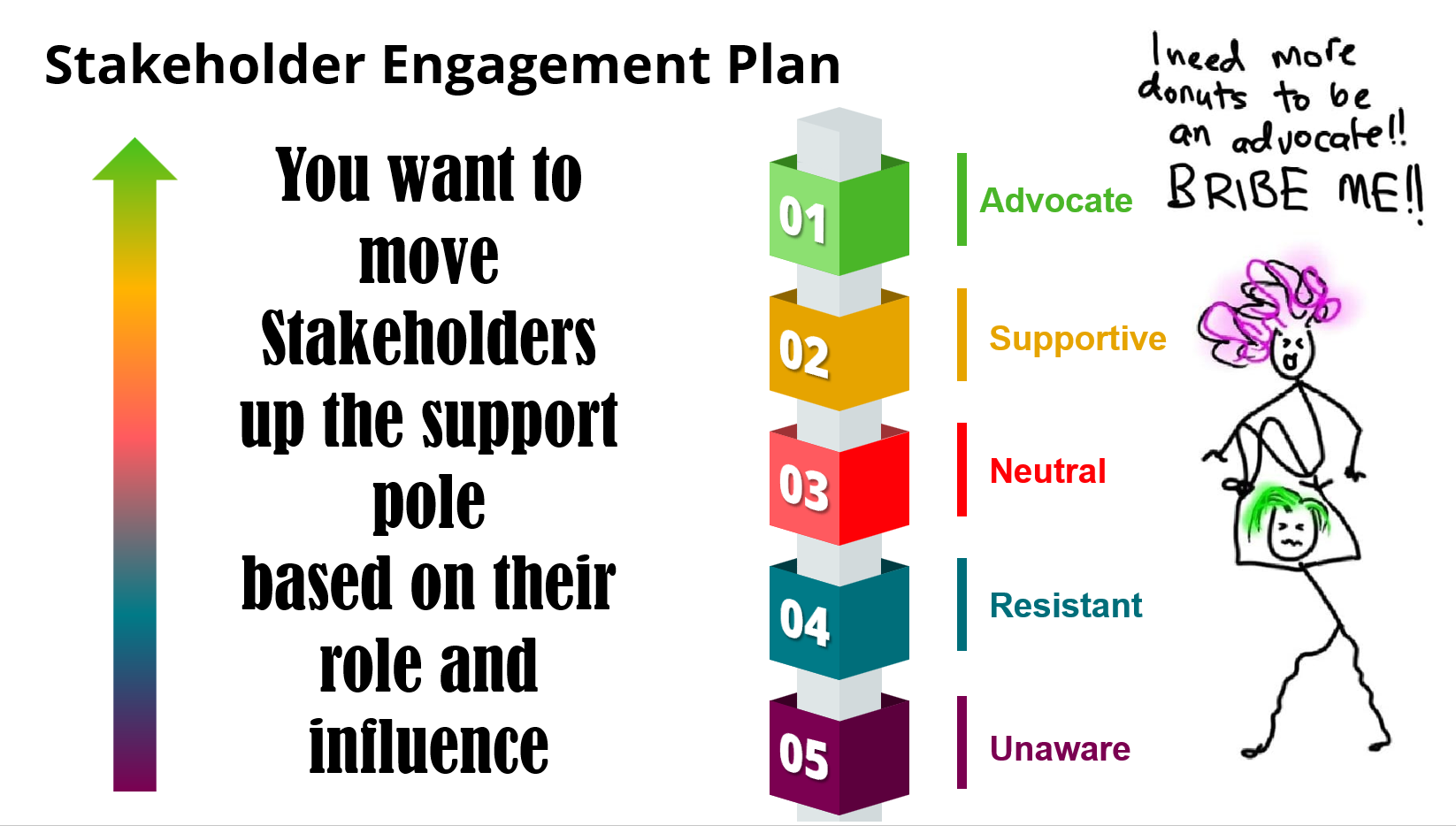
- The complete stakeholder mapping framework (power-interest matrix + engagement levels)
- All nine influence tactics grouped by the three R's (Reasoning, Reciprocity, Retribution)
- Why you should invest non-billable time with key stakeholders (and how to do it without seeming manipulative) - this is my secret weapon which is why I 🦹🏻♀️
- How to turn enthusiastic stakeholders into advocates without letting them create unrealistic expectations
- The "Modified Stand-Up with Feedback" exercise we use to practice active listening (directly transferable to client discovery)
- Strategic analysis of seven different stakeholders in the merger scenario—including which ones to invest time in, which to keep satisfied, and which to simply monitor
Want the full story? I've uploaded comprehensive notes from the entire session—all 15,000 words of it. It's based on the case study with detailed stakeholder profiles, strategic engagement plans for each person, and the actual conversation transcripts showing how we worked through the decisions in real time.
And we haven't quite finished yet and will probably be working through this for the next few weeks - as we dig into each persona and work through their motivations and how we would engage them to set up the project for success.
If you've ever found yourself thinking "I wish I knew how to handle this political situation" or "Why is this stakeholder being so difficult?" - these notes will give you frameworks and language you can use immediately.
Want to join us for the next session?
This is exactly what we work on EVERY WEEK in #ZenClub - taking messy, real-world scenarios and figuring out how to navigate them without a script.
I focus on the human centric-side of project delivery - emotional intelligence, consulting methodology, project management principles and Piyusha Pilania (MVP, Golden Hoodie) delivers the technical side, being an expert in Slack, Sales & Marketing Cloud as well as Agentforce.
That's what ZenClub is for.
It's £169 per month, for weekly group coaching and training on the skills certification and trailhead doesn't teach.
🍩Four live sessions (per month).
🍩Two expert facilitators.
🍩Real scenarios from working consultants.
🍩Plus you're building relationships with other consultants who understand your challenges - the kind of network that pays dividends for years.
Most professional communities charge this for monthly networking alone, never mind the actual training.
Learn more about ZenClub and join our community here.
Next week, we're back to our regularly scheduled Well-Architected programming. But sometimes the messy stuff is too valuable not to share.
Pei
P.S. The most popular question from this session? "How do you manage stakeholders when you're trapped in a terrible contract?"
Turns out, many of you are living this reality right now. Fixed price before discovery. Impossible timelines. Political landmines everywhere. And you can't walk away because you need the work.
The full notes have an entire section on this - including why sometimes you can't run from bad projects, how your stakeholder map becomes your survival tool when you're in crisis mode, and what to focus on when you can't change the contract terms but you still have to make it work.
It's the conversation nobody else is having. But it's the reality many consultants face every day.
P.P.S. Next ZenClub session is January 30th and we're doing something different - Piyusha's teaching Tableau basics. Then we're back to stakeholder management Part 3 to continue the merger case study. If you want in, now's the time. Spots are limited because we keep it intimate enough for real conversation.
P.P.P.S. If you love this newsletter and you want it to plop into your inbox without you having to do anything... subscribe here! 🥰 That would make me so happy!

Responses